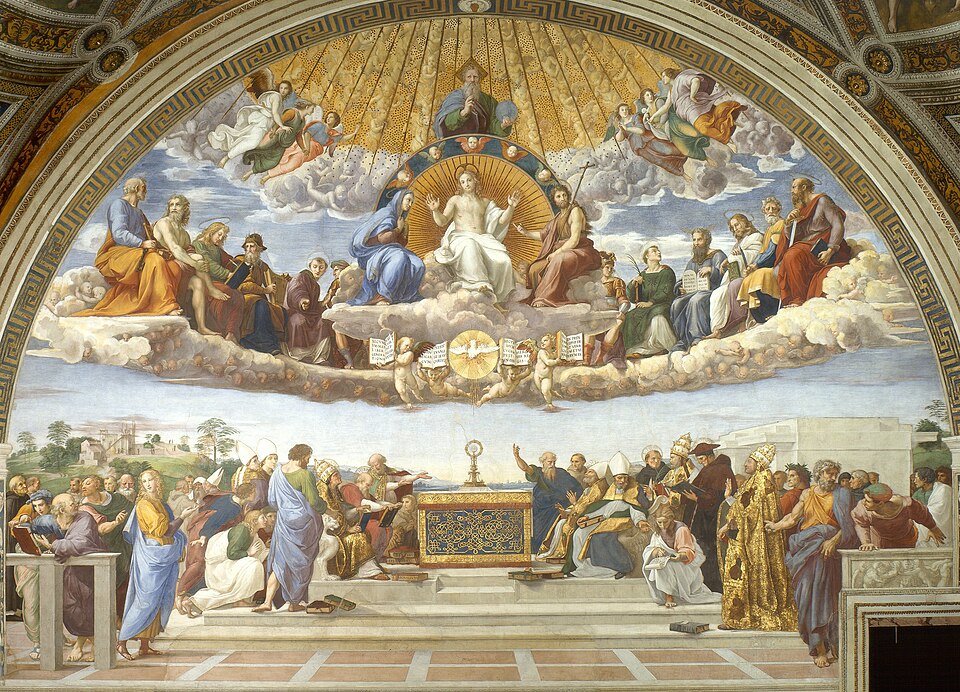
The Eucharist
The Body and Blood of Christ
They abstain from the Eucharist and from prayer, because they confess not the Eucharist to be the flesh of our Saviour Jesus Christ, which suffered for our sins, and which the Father, of His goodness, raised up again.
In plain words
Some people stay away from the Eucharist and from prayer, because they will not admit that the Eucharist is the Body of Jesus: the Body that suffered for our sins, and that the Father raised from the dead.
A modern paraphrase, not the saint’s own words.
For not as common bread and common drink do we receive these; … the food which is blessed by the prayer of His word … is the flesh and blood of that Jesus who was made flesh.
In plain words
We do not receive this as ordinary bread and drink. The food that has been blessed with the prayer of His word is the Body and Blood of Jesus, who became man.
A modern paraphrase, not the saint’s own words.
Godhead here in hiding, whom I do adore, masked by these bare shadows, shape and nothing more. See, Lord, at Thy service low lies here a heart lost, all lost in wonder at the God Thou art.
In plain words
Lord, You are God, hidden here, and I adore You. All I can see is the look and shape of bread, nothing more. I kneel before You, Lord, my heart lost in wonder at who You are.
A modern paraphrase, not the saint’s own words.
The Eucharist is my highway to Heaven.
The Sacrament
Eucharistic Miracles
History
Jesus gave us the Eucharist at the Last Supper, “the same night in which he was betrayed” (1 Corinthians 11:23), the night before His Passion. He took bread and said, “This is my body, which is given for you,” and then the chalice, “the new testament in my blood, which shall be shed for you” (Luke 22:19–20). So the Eucharist can never be separated from His suffering and death: every Mass makes present His one sacrifice on the Cross. The first Christians believed this from the start, as St. Ignatius and St. Justin wrote in the century after the Apostles.
In the Middle Ages, love for Jesus in the Host grew. Around 1200, priests began to lift the Host high after the Consecration so that all could see and adore Him. In 1215 the Fourth Lateran Council used the word “transubstantiation” for the change of bread and wine into His Body and Blood. In 1264 Pope Urban IV made Corpus Christi a feast for the whole Church, and St. Thomas Aquinas is credited with its hymns. Processions carried the Host through the streets in a monstrance, made so that the Host could be seen, and in 1551 the Council of Trent affirmed again that Christ is truly present.
In 1905 Pope St. Pius X urged Catholics to receive Communion often, even daily, and in 1910 he allowed children to receive as soon as they reach the age of reason. Today many parishes have chapels for Eucharistic Adoration, some open day and night. From 2022 to 2025 the bishops of the United States led a National Eucharistic Revival, with a National Eucharistic Congress in Indianapolis in July 2024.