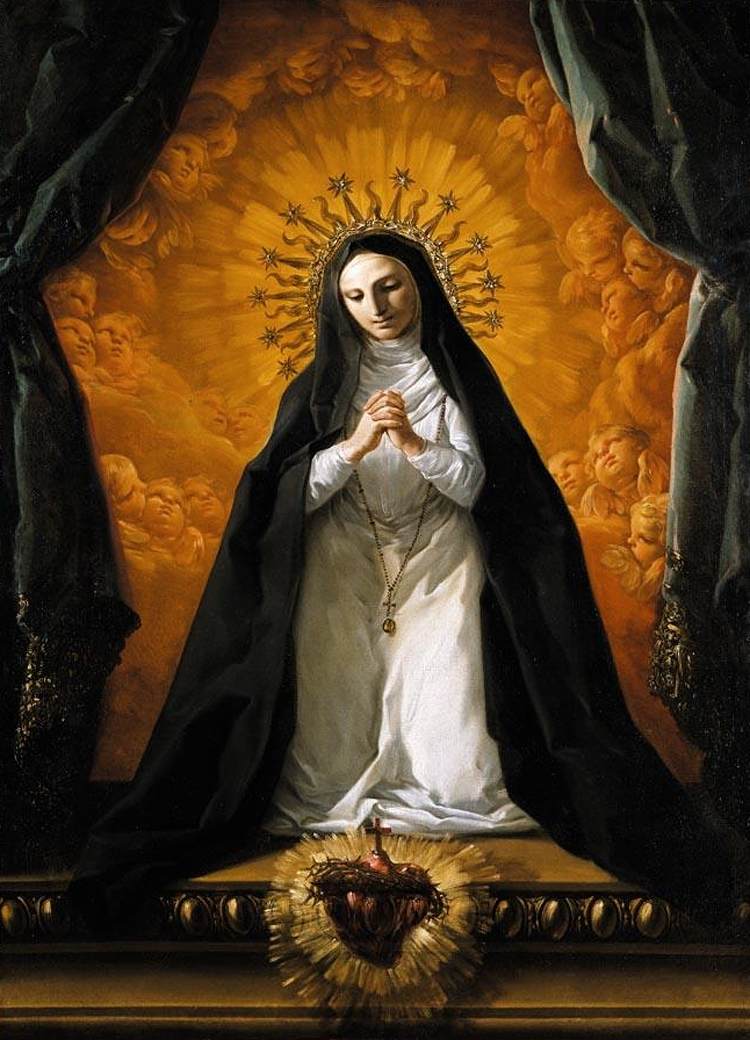
Sacred Heart & Divine Mercy
The love of His Heart, and the mercy that flows from it
Behold this Heart which has so loved men that it has spared nothing, even to exhausting and consuming itself, in order to testify its love.
In plain words
Look at this Heart, which loves people so much that it held nothing back, but gave itself up completely to show them its love.
A modern paraphrase, not the saint’s own words.
A suggestive word was made use of by the evangelist, in not saying pierced, or wounded His side, or anything else, but opened; that thereby, in a sense, the gate of life might be thrown open, from whence have flowed forth the sacraments of the Church.
In plain words
St. John chose his word carefully. He did not write that the soldier pierced or wounded Jesus’ side, but that he opened it, because a door to life was opened there, and from it came the sacraments of the Church.
A modern paraphrase, not the saint’s own words.
Mankind will not have peace until it turns with trust to My mercy.
The Sacred Heart
Divine Mercy
History
Christians have always loved the pierced side of Jesus, from which flowed blood and water. In the Middle Ages, saints such as St. Bernard, St. Bonaventure and St. Gertrude wrote of His wounded Heart as a refuge. In 1672 St. John Eudes celebrated the first feast of the Heart of Jesus. Between 1673 and 1675 Jesus showed His Heart to St. Margaret Mary at Paray-le-Monial, and the devotion spread across the world. Pope Pius IX made the feast of the Sacred Heart a feast for the whole Church in 1856, and in 1899 Pope Leo XIII consecrated the whole human race to the Sacred Heart.
In 1931 Jesus appeared to St. Faustina Kowalska in Płock, Poland, and asked her to spread the message of His mercy. The first Divine Mercy image was painted in Vilnius in 1934. After her death in 1938, the devotion spread quickly through Poland during the Second World War. In 1959, because of poor translations of her writings, Rome halted the spread of the devotion; after a careful study, begun by Archbishop Karol Wojtyła of Kraków, the ban was lifted in 1978, months before he became Pope John Paul II.
Pope St. John Paul II made St. Faustina a saint and established Divine Mercy Sunday in 2000, and consecrated the world to Divine Mercy at Kraków-Łagiewniki in 2002. In 1956 Pope Pius XII wrote a whole encyclical on the Sacred Heart, Haurietis Aquas, and in 2024 Pope Francis wrote another, Dilexit Nos, “He loved us.” The two devotions meet in one place: the open Heart of Jesus on the Cross, from which His love and mercy pour out on the world.