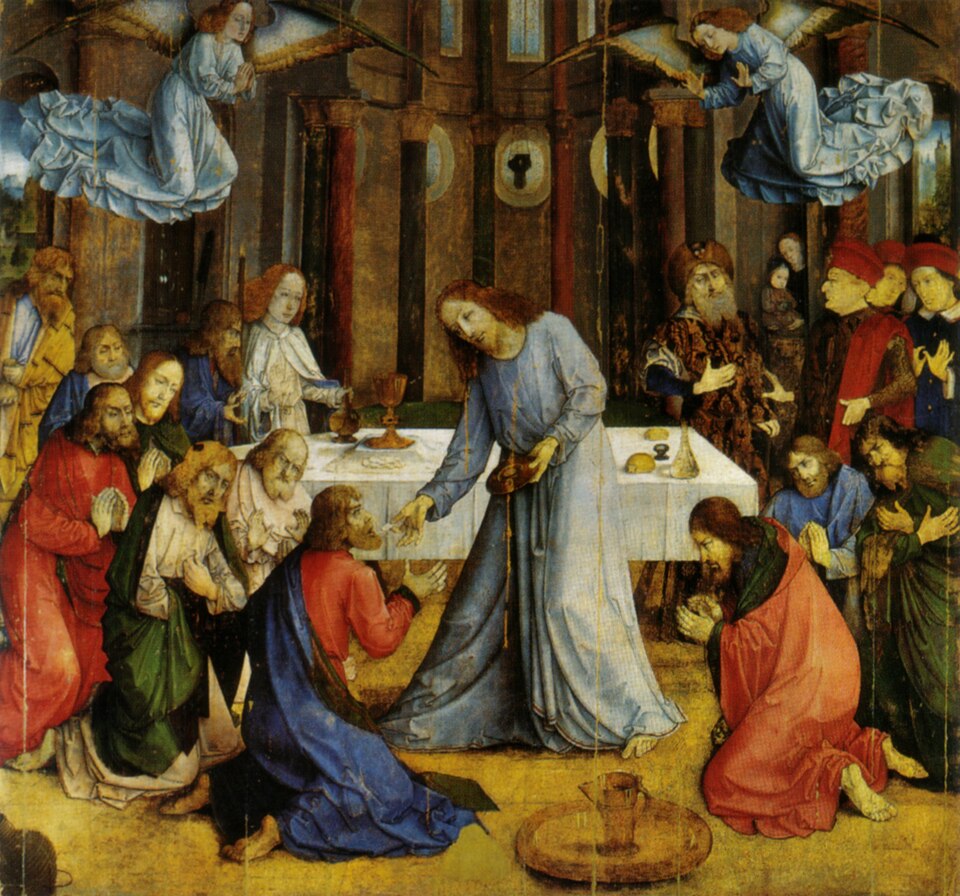
The Holy Mass
What happens at Mass, part by part
Let the entire man be seized with fear; let the whole world tremble; let heaven exult when Christ, the Son of the Living God, is on the altar in the hands of the priest.
In plain words
Let all of us be filled with awe, let the whole world tremble, and let heaven rejoice when Christ, the Son of the living God, is on the altar in the priest’s hands.
A modern paraphrase, not the saint’s own words.
It is easier for the earth to exist without the sun than without the holy Sacrifice of the Mass.
To ‘live’ the holy Mass means to pray continually, and to be convinced that, for each one of us, this is a personal meeting with God.
This sacrifice is so decisive for the salvation of the human race that Jesus Christ offered it and returned to the Father only after he had left us a means of sharing in it as if we had been present there.
In plain words
Jesus’ sacrifice on the Cross matters so much for our salvation that, before He returned to the Father, He gave us a way to share in it as if we had been there ourselves: the Mass.
A modern paraphrase, not the saint’s own words.
The Parts of the Mass
Every Mass has these same four parts. A few prayers change with the day and the season: the Gloria and the Creed are prayed on Sundays and great feasts, the Alleluia is not sung during Lent, and a wedding or funeral Mass adds prayers of its own. In the four pages, the steps marked Sundays are the ones that change. Sunday and Weekday Mass, below, shows the differences side by side.
Going to Mass
Offering the Mass
History
The Mass began at the Last Supper. On the night before He died, Jesus took bread and wine, gave them to His Apostles as His Body and Blood, and told them, “Do this for a commemoration of me” (Luke 22:19). From the very first days, Christians gathered on Sunday, the day of the Resurrection, for “the breaking of bread” (Acts 2:42).
About the year 155, St. Justin Martyr described a Sunday Mass in a letter to the Roman emperor: readings from the Apostles and the Prophets, a homily, prayers, bread and wine brought to the altar, a great prayer of thanksgiving answered by the people’s “Amen,” and Communion. That is the same shape the Mass has today. In Rome the Mass was first said in Greek; by the late 300s it was said in Latin.
In 1570, after the Council of Trent, Pope St. Pius V published the Roman Missal, and for four hundred years the Mass was said across the Western Church in Latin, in the same words. The Second Vatican Council asked that all the faithful take a full and active part, and in 1969 Pope St. Paul VI issued a new Roman Missal; the Mass came to be said in each people’s own language. Its heart has never changed: Christ’s one sacrifice made present, and His Body and Blood given to His people.